I listened to Kory Meyerink's list of the "50 Most Popular Genealogy Websites" on the Legacy Family Tree Webinar. I was surprised that I haven't hear about all of these websites before. They are worth taking a look.
Here's the list...
50. ScotlandsPeople.gov.uk
49. IAGenWeb.org
48. Linkpendium.com
47. GenesReunited.co.uk
46. SteveMorse.org
45. HeritageQuestOnline.com
44. GenealogyInTime.com
43. USGennet.org
42. RootsChat.com
41. AncestorHunt.com
40. NewspaperObituaries.net
39. GenealogyToday.com - blog list too
38. MyFamily.com
37. JewishGen.org
36. GenUKI.org.uk
35. FultonHistory.com - upstate NY
34. ProGenealogists.com
33. FamilyTreeMaker.com
32. BillionGraves.com
31. Geni.com
30. SortedByName.com
29. DeathIndexes.com
28. Mundia.com
27. Archives.com
26. OneGreatFamily.com
25. DAR.org
24. AccessGenealogy.com - Native American Resource
23. EOGN.com - Dick Eastman's Blog
22. CyndisList.com
21. AmericanAncestors.org - New England Historic Genealogical Society
20. Interment.net - cemeteries
19. EllisIsland.org
18. FindMyPast.co.uk $
17. GeneaNet.org - European
16. Newspapers.com $
15. GenealogyTrails.com
14. FamilyTreeDNA.com
13. RootsWeb.com
12. WikiTree.com
11. USGenWebArchives.net
10. AncientFaces.com
09. FamilyLink.com/WorldVitalRecords.com $
08. NewspaperArchive.com $
07. GenealogyBank.com $
06. Fold3.org $
05. FamilySearch.org
04. Genealogy.com $
03. FindAGrave.com
02. MyHeritage.com
01. Ancestry.com $
If you missed the Webinar it should be available on the website for the next week for free. If you are not watching these Webinars you are missing out.
19 March 2014

05 March 2014
John E. Carr - The death of a confederate soldier
While working on my genealogy research I came across an ancestor that was in my Legacy database but not found in FamilySearch. Long ago when I started using Legacy I entered in a family tree from the Carr family. The tree included some pictures and other data but I was new to the game and I blindly entered the information. I now know that this is not something I should have done but over time I have been able to tell the difference between the sourced material and the random family information I had blindly added to my tree.
John E. Carr was born in Pike County, Alabama in 1845, the oldest of six children, born to Richard and Mary Carr. John is enumerated in both the 1850 (age 5) United States Federal Census
 |
| Source Citation: Year: 1850; Census Place: , Pike, Alabama; Roll: M432_13; Page: 250A; Image: 506. |
 |
| Source Citation: Year: 1860; Census Place: Eastern Division, Pike, Alabama; Roll: M653_21; Page: 379; Image: 379; Family History Library Film: 803021. |
On 20 Aug 1863 John enlisted as a Private in Company A of the Alabama Infantry, 57th Regiment. (I know this enlistment form says 54th and 57th but later documents show just the 57th.)
 |
| Alabama, Civil War Service Records of Confederate Soldiers, 1861-1865," index, FamilySearch (https://familysearch.org/pal:/MM9.1.1/XXKD-DVR : accessed 06 Mar 2014), John E Carr, 1863 |
John's father Richard followed and enlisted 1 December 1863 also as a Private in Company A of the Alabama Infantry, 57th Regiment.
 |
| "Alabama, Civil War Service Records of Confederate Soldiers, 1861-1865," index, FamilySearch (https://familysearch.org/pal:/MM9.1.1/XXKD-DPN : accessed 06 Mar 2014), Richard Carr, 1864 |
In January of 1864 the Alabama 57th joined with the Army of Tennessee on its way to Atlanta. Casualties were minimal until the Battle of Peach Creek on 20 July 1864 in which almost 4,700 Confederate soldiers were killed. This was the first loss in the battle that led to the burning and fall of Atlanta 1 September 1864.
On 16 November 1864 General Sherman's Army of Georgia begins the "March to the Sea". At the time the Army of Tennessee had moved to Franklin Tennessee. On 30 November 1864 the Army of Tennessee is confronted by Union troops near Spring Hill, Tennessee. A massive frontal assault on the well entrenched Confederate line meets with disaster. The toll for Confederate forces is heavy including the loss of six of its generals. Union troops retreat in the direction of Nashville.
 |
| Flag of the 57th Alabama Infantry Co. A. |
On 15 December 1864, Union Major General George H.Thomas defeats Confederate Lieut. General John Bell Hood at Nashville in a complete victory that finally eliminates the Army of the Tennessee as a fighting force. This is where both John E. Carr and his father Richard R. Carr are captured as Prisoners of War.The father and son are then sent to separate prison camps.
On 16 January 1865 Richard R. Carr is transferred to Camp Chase in Columbus, Ohio. He dies of Pneumonia 8 Feb 1865.
 |
| "Alabama, Civil War Service Records of Confederate Soldiers, 1861-1865," index, FamilySearch (https://familysearch.org/pal:/MM9.1.1/XXKD-DPN : accessed 06 Mar 2014), Richard Carr, 1864 |

Much has been written and documented about Camp Douglas.
The above History Channel movie describes the camp as "80 Acres of Hell". There were few prison camps in the Civil War with worse living conditions than Camp Douglas. Punishments and torture were commonplace. As were prisoners being shot on sight for various offenses. Disease and illness were rampant throughout the camp causing the deaths of thousands of confederate prisoners. Newspaper accounts of how the prisoner's lived and died could not begin to describe the horrible conditions.
Based on the City Sexton's records up to 3,871 Confederate Prisoners of War were buried within Potter's field in the Chicago City Cemetery during the three years Camp Douglas was open. John E. Carr died of Pneumonia 18 March 1865, just three short months after his capture. As you can see in the below document he was buried in grave number 985, block 3 of the Chicago City Cemetery.
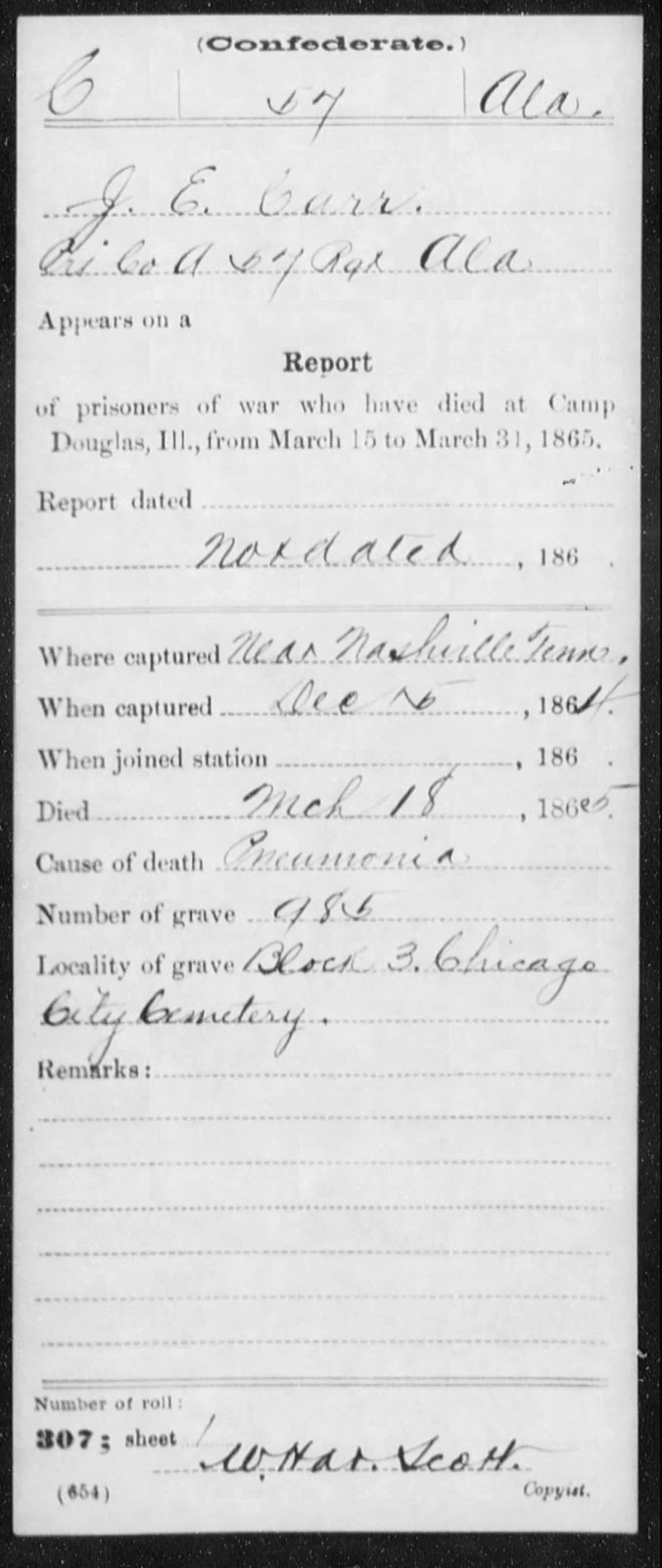 |
| "Alabama, Civil War Service Records of Confederate Soldiers, 1861-1865," index, FamilySearch (https://familysearch.org/pal:/MM9.1.1/XXKD-DVR : accessed 06 Mar 2014), John E Carr, 1863 |
Sadly, that is not the end of the story for John E. Carr. On 21 October 1864, just before General Sherman began his March to the Sea, The Common Council of the City of Chicago passed an ordinance establishing a public park on the North end of the Chicago City Cemetery. They also declared, "That hereafter, nobody shall be buried in the Chicago Cemetery, except in the Lots, which have been sold by the City." On 15 Feb 1865, a month before John's death, the City of Chicago and the Rosehill Cemetery Company entered into an agreement to set apart the appropriate ground for the park.
On 17 Dec 1866, nine months after John's burial, the Common Council of the City of Chicago sends a letter to Chief Quartermaster stating they, "were appointed, by said council, to confer with you, and through you, with the War department of the government, in relation to the removal of the bodies of prisoners interred in our City Cemetery, during the Rebellion."
The bodies of most of the Confederate soldiers buried in Potter's Field in the Chicago City Cemetery were then disinterred over the next 20 years. The building of a parking lot in 1998 uncovered another 181 bodies from the field.

This monument in the nearby Oakwoods Cemetery reads;
"The Confederate dead here buried in concentric trenches were all private soldiers. The monument to their memory is of Georgia granite, stands forty feet from the ground to the top of statue and was erected in July, 1893, with funds mainly subscribed by liberal citizens of Chicago and Camps of the United Confederate Veterans. The bronze panels of the pedestal die represent: On the east face, - THE CALL TO ARMS; On the west face, - A VETERANS RETURN HOME; And on the south face, - A SOLDIER’S DEATH DREAM. The bronze statue surmounting the battlemented cap of the column is a realistic representation of a Confederate Infantry soldier after the surrender. The face expresses sorrow for the thousands of prison dead interred beneath. The cannon shot and shell ornamenting this Government lot, in which both Union and Confederate dead are buried, were furnished by the War Department under authority of an Act of Congress approved January 25th, 1895."

A tablet on the memorial lists John E. Carr's name.

Mary Polly Carr lost both her husband and son in the Civil War. She continued to live in Alabama for 20 more years until she moved to Bosque County, Texas with her son Joseph Madison Carr.
04 March 2014
U.S. Citizenship and Immigration Services History and Genealogy Program
I recently saw a post on Dick Eastman's Online Genealogy Newsletter about U.S. Citizenship & Immigration Services to Hold Online Webinars. One of the link in his blog goes to the USCIS History and Genealogy Program. The program is a fee-based service providing
family historians
and other researchers with timely and
accurate access to historical immigration
and naturalization records.
I was surprised to find the the quality of records that are available through this website and I thought I would talk about the different types of records and what information they may contain. The USCIS has made five different sets of records available.
How to Make a Request
Requests may be submitted online using a credit card or by mail using a money order or cashier’s check. To make an online request, visit “Make a Genealogy Request”. Please be sure to read all of the instructions before submitting a request. Send questions and comments to Genealogy.USCIS@dhs.gov or leave a toll-free voice message at 1-866-259-2349.
The USCIS Genealogy Program offers two services:
I was surprised to find the the quality of records that are available through this website and I thought I would talk about the different types of records and what information they may contain. The USCIS has made five different sets of records available.
A-File example data includes: Post-WW II War Bride visas, Petitions for Relative Visas, AR-2 Registration Forms, Enemy Alien in World War II records, Consolidated A-Files report, Refugee Documents, Change of Address Cards, Application for Naturalization files, or duplicate of Certificate of Naturalization. A-File content is as unique as the individual it represents. They may have only a few pages or contain 100’s of pages in multiple folders. A-File content depends on the history of interaction between the immigrant and the agency.
AR2 example data includes: Answers to questions about the registrants name, present address, date of birth, place of birth, the port, date and ship of arrival, dates for first and last arrival, usual occupation, present occupation, name and address of employer, membership in any organization in the last five years, prior military service, if they have ever filed first papers for naturalization, criminal record including police and court records, and their mark or signature. Requests for AR-2 Forms must include the A-number. Researchers may find A-numbers on index cards to court naturalization records after 1941, on original alien registration receipt cards, or other of the immigrant’s personal papers. If the immigrant registered as an alien in 1940 their A-number can be learned from an Index Search request.
C-Files example data includes: The immigrant’s name, date and place of birth, and port, date of arrival, names of spouse and children, occupation, and place of residence when naturalized. Declarations of Intention and Naturalization Certificates issued after July 1, 1929, also include a picture of the petitioner. Certificate Files, or C-Files, document naturalizations and contain copies of records evidencing the Granting of naturalized U.S. citizenship by courts between from 1906 to 1956; and the Issuance of Certificates of Citizenship to those who derived or resumed U.S. citizenship.
Registry Files example data include: extensive biographical information, including the full and maiden names of both parents, details about the applicant’s arrival in the US, and specific data on their employment and residential history in the US. To prove residence in the US prior to July 1, 1924, some Registry applicants submitted employment records, character references from friends or employers, sworn affidavits from friends, neighbors, or co-workers; bank account or financial records, church records, and police or criminal background check records. The applicant’s eligibility was summarized in a “Findings” document recommending the application be granted or denied. The final document is a decision showing the application was granted or denied.
Visa Files example data include: Files for every immigrant admitted for permanent US residence between July 1, 1924 and March 31, 1944. The files consist of:
AR2 example data includes: Answers to questions about the registrants name, present address, date of birth, place of birth, the port, date and ship of arrival, dates for first and last arrival, usual occupation, present occupation, name and address of employer, membership in any organization in the last five years, prior military service, if they have ever filed first papers for naturalization, criminal record including police and court records, and their mark or signature. Requests for AR-2 Forms must include the A-number. Researchers may find A-numbers on index cards to court naturalization records after 1941, on original alien registration receipt cards, or other of the immigrant’s personal papers. If the immigrant registered as an alien in 1940 their A-number can be learned from an Index Search request.
C-Files example data includes: The immigrant’s name, date and place of birth, and port, date of arrival, names of spouse and children, occupation, and place of residence when naturalized. Declarations of Intention and Naturalization Certificates issued after July 1, 1929, also include a picture of the petitioner. Certificate Files, or C-Files, document naturalizations and contain copies of records evidencing the Granting of naturalized U.S. citizenship by courts between from 1906 to 1956; and the Issuance of Certificates of Citizenship to those who derived or resumed U.S. citizenship.
Registry Files example data include: extensive biographical information, including the full and maiden names of both parents, details about the applicant’s arrival in the US, and specific data on their employment and residential history in the US. To prove residence in the US prior to July 1, 1924, some Registry applicants submitted employment records, character references from friends or employers, sworn affidavits from friends, neighbors, or co-workers; bank account or financial records, church records, and police or criminal background check records. The applicant’s eligibility was summarized in a “Findings” document recommending the application be granted or denied. The final document is a decision showing the application was granted or denied.
Visa Files example data include: Files for every immigrant admitted for permanent US residence between July 1, 1924 and March 31, 1944. The files consist of:
- a large application document and all required documents submitted to support the application. Visa application form contains all information found on a ship manifest of the same date, as well as additional data. Included are the names of any minor children, the full and maiden names of both parents, and listing of all official documents attached or shown to the US Consul prior to issuance of the visa. the back of the visa application form summarizes the facts of the Immigrant’s arrival (port, date, ship), whether admitted on primary inspection or by a Board of Special Inquiry (BSI), and whether the BSI decision was appealed to Washington.
- a required certified copy of the immigrant’s birth certificate. If an official document was unavailable, the file will include an affidavit or some other substitute birth record.
- a required health certificate showing the immigrant was free from contagious disease or any disability that would hinder their ability to make a living in the US.
- a criminal background check record from their home country. These may be called “police certificates” or “morality certificates” or some other name depending on the country and date.
- for men of military service age, especially if their home country required military service before emigration, will include a certificate of military service.
How to Make a Request
Requests may be submitted online using a credit card or by mail using a money order or cashier’s check. To make an online request, visit “Make a Genealogy Request”. Please be sure to read all of the instructions before submitting a request. Send questions and comments to Genealogy.USCIS@dhs.gov or leave a toll-free voice message at 1-866-259-2349.
- Index Search - $20 - Using biographical information provided by the researcher, USCIS searches its historical immigration and naturalization record indices for citations related to a specific immigrant. The search results (record citations) are returned to the researcher, along with instructions on how to request the file(s) from USCIS, the National Archives, or local courts. To make an Index Search Request you will need to provide at least the following information about your immigrant ancestor: Name (aliases, maiden, and variations) and the Date and Country of birth (actual or estimated). You will also be asked to provide optional information, such as date of arrival in the US and places of residence. While this information is not required it is often essential for locating the correct index entries.
- Record Copy Request - $20 microfilm, $35 hard copy - Researchers, with valid USCIS file number, may request copies of historical immigration and naturalization records. The program can only fulfill record requests that include a valid file number, such as a naturalization certificate number. If you do not have a file number, or you are unsure whether or not USCIS maintains a file for your ancestor, please submit an index search request.
25 February 2014
Taking stock post RootsTech
It has been two weeks since my last post. I would have thought before RootsTech I would have a lot to write about in this blog. The truth is I feel as unfocused about where to go from here as before. I really did learn a lot at the conference and came back with several good ideas.
I mostly learned:
I feel like I am spinning my wheels.
I mostly learned:
- I have been incomplete in documenting my sources.
- I still do not have a grasp on how I should keep a research log.
- I need to be keeping research notes.
- I need to share more while only giving spoonfuls at a time.
- There is more to genealogy than documents and sources.
- I wasn't ready for DNA and I don't think it is ready for me either.
- I have 8588 people in my legacy database with over 50,000 individual source attributions or events.
- I have 3319 people in my ancestry.com profile with 6,050 records, 219 stories, 713 photos, and 7449 shaky leaf hints.
- I have 260 contributions to Wiki-tree.
- I started adding sources and pictures to Family Tree and created a watch-list for 369 individuals.
- I started five different family Facebook pages and posted information and pictures to share.
- I started this blog, joined Google+, updated my twitter and Instagram accounts.
I feel like I am spinning my wheels.
11 February 2014
There seems to be a thread - Carpenter Seed Pt. 3
I know I have blogged about this before but I feel like I need to follow keep updating things when new information arises.
Last week, while I was attending RootsTech my favorite uncle posted another series of pictures he found from Carpenter Seed. Although he didn't narrate them I thought they contributed to the story as a whole.
 This is what Carpenter Seed looked like when it opened. It still looks this way in the front when you drive by on Highway 89.

This is the fish and game section of the store. This was the back wall of the building until they opened it up for more retail space. My Uncle Darce says he can smell the leather when he looks at this picture.

This is the home and garden section of the store. The loft in the back of the room at the top of the picture was where the business office was. I remember when I was old enough to go upstairs to what my dad called the 'coffee clutch' and shoot the bull with my relatives. It made me feel important to go up there and a part of something bigger than me. I wish I could go back up there one more time and enjoy the atmosphere, and ask some questions.

This is my favorite picture of this set of pictures. It is taken from the business loft with the wall of guns on the right. My grandpa Trotter is the closest man in the white shirt behind the counter. Carpenter Seed would let you reload your shells for free if you bought the supplies from the store. These men are all reloading shells, it must be warm outside because most of them are wearing short sleeve shirts. At the top of the picture, along the south wall of the store, are the seeds. Six racks 10 rows deep of the finest seeds in the inter-mountain and south west.
My Aunt Connee discussed these photos at lunch in-between sessions of RootsTech. She mentioned in passing that she saw one of the old seed boxes online that a women had purchased for $5 at a yard sale. I asked where and she said she would try and send me a picture. I by chance googles Carpenter Seed and behold... I found the pictures on a blog called Have a Daily Cup of Mrs Olsen.

This is the old seed box that doubled as a display box.

When closed the seeds crates could be stacked and stored. When open they looked great and helped to sell the seed.

Mrs. Olsen now uses it for holiday decorations, this is a family heirloom to drool over. Thanks again to my favorite uncle for passing on his experiences and pictures. Special thanks to Mrs. Olsen for finding this piece of family history and sharing it so we can all benefit. This chapter of our family history is writing itself and I am sure enjoying the ride. Now to document the pictures into the collection.
Last week, while I was attending RootsTech my favorite uncle posted another series of pictures he found from Carpenter Seed. Although he didn't narrate them I thought they contributed to the story as a whole.


This is the fish and game section of the store. This was the back wall of the building until they opened it up for more retail space. My Uncle Darce says he can smell the leather when he looks at this picture.

This is the home and garden section of the store. The loft in the back of the room at the top of the picture was where the business office was. I remember when I was old enough to go upstairs to what my dad called the 'coffee clutch' and shoot the bull with my relatives. It made me feel important to go up there and a part of something bigger than me. I wish I could go back up there one more time and enjoy the atmosphere, and ask some questions.

This is my favorite picture of this set of pictures. It is taken from the business loft with the wall of guns on the right. My grandpa Trotter is the closest man in the white shirt behind the counter. Carpenter Seed would let you reload your shells for free if you bought the supplies from the store. These men are all reloading shells, it must be warm outside because most of them are wearing short sleeve shirts. At the top of the picture, along the south wall of the store, are the seeds. Six racks 10 rows deep of the finest seeds in the inter-mountain and south west.
My Aunt Connee discussed these photos at lunch in-between sessions of RootsTech. She mentioned in passing that she saw one of the old seed boxes online that a women had purchased for $5 at a yard sale. I asked where and she said she would try and send me a picture. I by chance googles Carpenter Seed and behold... I found the pictures on a blog called Have a Daily Cup of Mrs Olsen.

This is the old seed box that doubled as a display box.

When closed the seeds crates could be stacked and stored. When open they looked great and helped to sell the seed.

Mrs. Olsen now uses it for holiday decorations, this is a family heirloom to drool over. Thanks again to my favorite uncle for passing on his experiences and pictures. Special thanks to Mrs. Olsen for finding this piece of family history and sharing it so we can all benefit. This chapter of our family history is writing itself and I am sure enjoying the ride. Now to document the pictures into the collection.
10 February 2014
Genealogy and Social Media - Amber Marie Bellows Butler
My mother made this Facebook post February 9, 2014.
 This is not typical of the kind of genealogy information I find on social media.
I feel loss and sorrow for Amber, her husband and the rest of her family; but to be honest I am not sure how I am related to Amber. My uncle Followed up with this post.
 With the information from these two posts, I opened up Legacy to see where in the family Amber fits. I quickly discovered that despite meeting these relatives at several family reunions I feel fuzzy about my knowledge of them and I have even less information in my files.


Luckily I found Edyth and Jan where I thought they would be. Amber is not in my records but based on the clues from Facebook I have found where she belongs. Now I know how I am related to Amber I want to find out more about Amber. A quick Google search turns up several photos, her Facebook page, news stories about the event, and videos of Amber base-jumping.
The news reports say she had been married to her husband Clayton for only two weeks before she died.

The blog http://dailyentertainmentnews.com posted information about Amber's wedding date and location as well as her parents names. The blog also posted links to both Amber and Clayton's Facebook pages.

After Amber and Clayton were married they jumped from their hotel room balcony in Las Vegas.

Of the many things I learned today about Amber I am sure she died doing the thing she loved with the person she loved. I wish I have know her better.
Amber Marie Bellows Butler
Born: 1986
Married: January 26, 2014
Died: February 8, 2014
Father: Boyd Kay Bellows
Mother: Jan Marie Erickson Bellows
Siblings: Zachary, Brandon, and Kelli Bellows

I feel loss and sorrow for Amber, her husband and the rest of her family; but to be honest I am not sure how I am related to Amber. My uncle Followed up with this post.


From my mother and uncle's posts, I figured out that I am looking for Edyth's granddaughter, Amber Bellows. Since my uncle Darce says she is his cousin's daughter, I know that Edythe is either my Grandfather or Grandmother's sister.

Luckily I found Edyth and Jan where I thought they would be. Amber is not in my records but based on the clues from Facebook I have found where she belongs. Now I know how I am related to Amber I want to find out more about Amber. A quick Google search turns up several photos, her Facebook page, news stories about the event, and videos of Amber base-jumping.
The news reports say she had been married to her husband Clayton for only two weeks before she died.
The blog http://dailyentertainmentnews.com posted information about Amber's wedding date and location as well as her parents names. The blog also posted links to both Amber and Clayton's Facebook pages.
After Amber and Clayton were married they jumped from their hotel room balcony in Las Vegas.

Of the many things I learned today about Amber I am sure she died doing the thing she loved with the person she loved. I wish I have know her better.
Amber Marie Bellows Butler
Born: 1986
Married: January 26, 2014
Died: February 8, 2014
Father: Boyd Kay Bellows
Mother: Jan Marie Erickson Bellows
Siblings: Zachary, Brandon, and Kelli Bellows
02 February 2014
My path to RootsTech 2014
I have been excitedly reading all of the blog posts of people who are leaving today for the RootsTech conference in Salt Lake City. I am excited to go also but I am afraid I am not as prepared to go as some of the official bloggers.

I live about a half an hour north of Salt Lake in Ogden, Utah. My wife and I plan on staying in Salt Lake on Wednesday and Thursday night. She will be leaving on Friday morning to help get the kids situated I will ride the train home on Friday night and drive down on Saturday morning.
I feel prepared for the weather, where to eat, how long it will take to get around, etc. But I am feeling the pressure of being unprepared for the conference. I have lived within 40 miles of Salt Lake City for my entire life and I have only been to the Family History Library three times. (Yes, I am ashamed to admit it.) On only one of these visits did I find records that I was looking for.

It is kind of like skiing for me. I have only been skiing a few times in my life and I have not been skiing since I got married. In Utah of all places, the greatest snow on earth! However unlike skiing, I have found myself in a digital world of genealogy. Not that the Internet can solve all of my genealogical problems but I have have been gathering information in an Internet age.

I have gone to the Ogden Family History Library several times. I have search through books and taken classes. The last time I went down, I was asking about finding records in the library. I really feel like I am missing the 'old school' knowledge that many of the teachers and volunteers there have. I was armed with the information from my Brick Wall ancestor and I really wanted someone to take a look and give me a suggestion of where to look for more information. As I asked around they pointed me to the best person to guide me. He is a South-Eastern United States specialist and a 'wiz' on the computer.
As we were talking, he guided me back to a computer to look for information. Each step he took was one I had done at home. I felt like I knew these files almost as well as he did. By the end of the evening I learned:
RootsTech seems right for me. A mix of technology and genealogy that I can learn form those who know more than I do. I hope I can maximize my time at the conference and learn things that will give me direction for the next year.

I live about a half an hour north of Salt Lake in Ogden, Utah. My wife and I plan on staying in Salt Lake on Wednesday and Thursday night. She will be leaving on Friday morning to help get the kids situated I will ride the train home on Friday night and drive down on Saturday morning.
I feel prepared for the weather, where to eat, how long it will take to get around, etc. But I am feeling the pressure of being unprepared for the conference. I have lived within 40 miles of Salt Lake City for my entire life and I have only been to the Family History Library three times. (Yes, I am ashamed to admit it.) On only one of these visits did I find records that I was looking for.
It is kind of like skiing for me. I have only been skiing a few times in my life and I have not been skiing since I got married. In Utah of all places, the greatest snow on earth! However unlike skiing, I have found myself in a digital world of genealogy. Not that the Internet can solve all of my genealogical problems but I have have been gathering information in an Internet age.

I have gone to the Ogden Family History Library several times. I have search through books and taken classes. The last time I went down, I was asking about finding records in the library. I really feel like I am missing the 'old school' knowledge that many of the teachers and volunteers there have. I was armed with the information from my Brick Wall ancestor and I really wanted someone to take a look and give me a suggestion of where to look for more information. As I asked around they pointed me to the best person to guide me. He is a South-Eastern United States specialist and a 'wiz' on the computer.
As we were talking, he guided me back to a computer to look for information. Each step he took was one I had done at home. I felt like I knew these files almost as well as he did. By the end of the evening I learned:
- I was pretty up to speed with the Internet resources that were available.
- That my brick wall was not going to be torn down in a evening.
- That the Ogden Family History Library spends a lot of time teaching people how to use a computer and how to use online sources.
- That the majority of people who are looking for help are either youth who are inexperienced with genealogy or people 10-20 years older than me who are inexperienced with computers.
- Those who are my age in the building are spending a significant amount of time teaching.
RootsTech seems right for me. A mix of technology and genealogy that I can learn form those who know more than I do. I hope I can maximize my time at the conference and learn things that will give me direction for the next year.
28 January 2014
My Brick Wall Ancestor
I love working on genealogy. I like learning about my family members, the places that they have lived and the reasons they move from place to place. I love to find the happy stories and find courage in the sad. I have felt both pride and sorrow for people I have never met. I am also thrilled when I find an immigrant ancestor and a link to another country or homeland.

I also like fitting the pieces of the puzzle together. Finding the census record with the name of a mother-in-law that leads to a marriage certificate. Genealogists know the thrill of finding a record that leads to another and another. I even enjoy the feeling of finding a record that validates an entry in an pedigree without sources.

I can't say that I enjoy the brick walls, the lines that end without any clues. I realize that some lines end because of how far back the family goes. The time or locality make it difficult to find more information. From what I have read many brick walls are because a source or fact is wrong or misinterpreted. I think my brick wall is a combination of these reasons.

The consensus from most sources is that to break a brick wall you should start with what you know about the closest relative to the brick wall. In this case that is Samuel Thomas Trotter. I do not have a birth record for Samuel but I do have a Death Certificate. Here is where the brick wall starts.
This document is the only record I can find with that name of Samuel's father James Trotter. Death Certificates are primary sources for the death information for the individual. However, the information included on the death certificate that does not have to do with the death is not as reliable. This non-death information, although at times accurate, is second hand. The credibility of this information is dependent on the person who gives it, in this case the death informant.
From Samuel's death certificate is the following information:

I also like fitting the pieces of the puzzle together. Finding the census record with the name of a mother-in-law that leads to a marriage certificate. Genealogists know the thrill of finding a record that leads to another and another. I even enjoy the feeling of finding a record that validates an entry in an pedigree without sources.

I can't say that I enjoy the brick walls, the lines that end without any clues. I realize that some lines end because of how far back the family goes. The time or locality make it difficult to find more information. From what I have read many brick walls are because a source or fact is wrong or misinterpreted. I think my brick wall is a combination of these reasons.

The consensus from most sources is that to break a brick wall you should start with what you know about the closest relative to the brick wall. In this case that is Samuel Thomas Trotter. I do not have a birth record for Samuel but I do have a Death Certificate. Here is where the brick wall starts.
 |
| Click image to view a larger version |
From Samuel's death certificate is the following information:
- Birth date - 15 Feb 1860
- Birthplace - Greensbrough, Louisiana
- Father - James Trotter; birth place not know
- Mother - Ruth Glasscock; birth place Louisiana
As I have done subsequent research I found that:
- I cannot verify this birth date - The only two sources I can find for that agree with this date are his obituary and his grave. All three of these sources are secondary.
- The birthplace does not exist - There is evidence that the family is from Greensburg, St. Helena Parish, Louisiana. I have an 1850 Census from Greensburg with a Ruth Trotter and son Saml.
- I cannot find any record of James. It is reasonable to assume that Ruth had a relationship with a Trotter. I cannot find any record with the name James. The closest I can find is from Samuel's brother William, whose middle name is Jasper.
- I cannot find a Ruth Glasscock - However, There are several sources for Ruth Trotter including three census records, two land records, and two interesting new articles about her getting stabbed by a Hazel Woods.
From the information I have found, I cannot find one Primary source to verify any of this information. The information I can verify in family records is based on the name Ruth Trotter. I am not sure if Ruth Trotter is a fit or if I am trying to make the puzzle piece fit in the wrong puzzle.
I am open to suggestions or questions. I have spend a lot of time working on this brick wall.
25 January 2014
The lessons learned when beginning genealogy
When I was in my early 20's and newly married I took a family history class at my church. The veteran teacher of the class told me about a free genealogy software that people are using to track their genealogy. He personally had not used it but someone younger like me should "take to it".
I download the software and went through the motions of copying any genealogy information I had into it. I had built a rough tree of my direct ancestors. The other weeks in the class were focused on interviewing family members for information, how to fill out pedigree charts and family group sheets by hand, and trying to gather pictures to add to my pedigree chart. As an LDS class we also talked about preparing the names to take to the temple.
Looking back, I learned about fundamental tools used in genealogy. I learned the basic framework of my family tree, and I spoke to family members about genealogy and learned who had information. I think the biggest thing I got from the class was a desire to do more.
I soon registered for a class at the Ogden Family History Center. They also encouraged me to use PAF, but the teacher recommended that I add my child and my wife's family to my tree. So I proceeded to find and copy family pedigrees into PAF. They also encouraged mt to try and gather photographs of the people in my pedigrees and family group sheets.
Soon after I started taking these classes I was asked to serve as a Cubmaster in my local Pack and my attention and resources were soon diverted to Scouting.
About ten years later, I took another family history class at my church. I had worked my way through scouting from Cubmaster to Scoutmaster and I had found myself in a position where I wasn't working with the boys on a weekly basis. I had a desire to spend my time with genealogy again. This class was also taught by a veteran couple, named the Gabberts, but they used software to track their genealogy. The first lesson they taught was the importance of using software. They talked about PAF but suggested that I download a free trial from another vendor and try to use that. PAF was good but the other others offered more features.
 The Gabbert's like to use Legacy and they showed the software and how they used it. They also said I could create a GEDCOM file and import the information I have from PAF to Legacy. I started with the free version of Legacy 7. After the import I immediately saw issues with my file. I had holes, loops, and duplicates. I hadn't recorded full families, place names or sources. What I had was a skeleton framework. A work in progress. The Gabbert's suggested that I keep the information from PAF in one Legacy file but that I start a new file and that I start with my oldest son as the first person.
As I started adding names to the new file and I could add sources and pictures. By no means is my file perfect but over the years I have gathered roughly 8500 individuals in over 2780 families using 717 sources.
 |
| This software has been discontinued |
Looking back, I learned about fundamental tools used in genealogy. I learned the basic framework of my family tree, and I spoke to family members about genealogy and learned who had information. I think the biggest thing I got from the class was a desire to do more.
I soon registered for a class at the Ogden Family History Center. They also encouraged me to use PAF, but the teacher recommended that I add my child and my wife's family to my tree. So I proceeded to find and copy family pedigrees into PAF. They also encouraged mt to try and gather photographs of the people in my pedigrees and family group sheets.
Soon after I started taking these classes I was asked to serve as a Cubmaster in my local Pack and my attention and resources were soon diverted to Scouting.
About ten years later, I took another family history class at my church. I had worked my way through scouting from Cubmaster to Scoutmaster and I had found myself in a position where I wasn't working with the boys on a weekly basis. I had a desire to spend my time with genealogy again. This class was also taught by a veteran couple, named the Gabberts, but they used software to track their genealogy. The first lesson they taught was the importance of using software. They talked about PAF but suggested that I download a free trial from another vendor and try to use that. PAF was good but the other others offered more features.
As I started adding names to the new file and I could add sources and pictures. By no means is my file perfect but over the years I have gathered roughly 8500 individuals in over 2780 families using 717 sources.
23 January 2014
FamilySearch Family Tree Watch List
When I attended the Ogden Family History Conference last September the Keynote speaker was Ron Tanner. Ron is product manager for the Family History Department of the LDS Church. His bio from the conference says that, "his primary responsibility is to lead a team doing research and design of Family Tree and companion products."
Ron described functionality of Family Tree as well as some of the products that work with Family Tree. One functionality that he highlighted was the watch list.

As you navigate the tree you can click on the name of any person and a small details box pops up for that person. Details include an image of the person (if one is loaded), full name, ID number, birth and death information, as-well-as the number of sources, photos, discussions, or stories that have been attached to the person. For members of the LDS church it also shows temple information. The cursor is pointed to the Watch/Unwatch feature.

The same information appears on the persons details page. Each Friday I receive an email from FamilySearch detailing any of the changes that have been made to each of the people on my watch list. You can also view your watch list by clicking the Lists link in the navigation bar on Family Tree.

My watch list shows 240 people that I am watching. This is also the number of detail pages I have added sources, pictures and other information. I could go through and check all of my people in the tree but this is a quick and easy way to check my progress

Clicking the 'Changed To People I'm Watching" link shows that there a 826 changes to the details pages of the people I am watching.

Most of the changes are generated by people merging or deleting duplicate information. As you can see in this image above, Stanley Roberts, who I don't know, detached a source for one of our common relatives. If you click on the person's name the link takes you to their detail page.

On the right side of the detail page is a box with the three latest changes for your person's detail page. Clicking the show all link in the box allows you to see the changes that were made to the detail page.

The information shows that on 22 January 2014, Stanly Roberts detached the source "Massachusetts, Marriages, 1695-1910" because "he found better data". I have used this list to see if someone had added new pictures, made changes to data I have verified, or merged two files.
The number 826 seems like a large number of changes but that is the total since I started my watch list. Each Friday I review only the changes for the previous week. It has made it easy to collaborate with others and identify new sources of information.
Ron described functionality of Family Tree as well as some of the products that work with Family Tree. One functionality that he highlighted was the watch list.

As you navigate the tree you can click on the name of any person and a small details box pops up for that person. Details include an image of the person (if one is loaded), full name, ID number, birth and death information, as-well-as the number of sources, photos, discussions, or stories that have been attached to the person. For members of the LDS church it also shows temple information. The cursor is pointed to the Watch/Unwatch feature.
The same information appears on the persons details page. Each Friday I receive an email from FamilySearch detailing any of the changes that have been made to each of the people on my watch list. You can also view your watch list by clicking the Lists link in the navigation bar on Family Tree.
My watch list shows 240 people that I am watching. This is also the number of detail pages I have added sources, pictures and other information. I could go through and check all of my people in the tree but this is a quick and easy way to check my progress
Clicking the 'Changed To People I'm Watching" link shows that there a 826 changes to the details pages of the people I am watching.
Most of the changes are generated by people merging or deleting duplicate information. As you can see in this image above, Stanley Roberts, who I don't know, detached a source for one of our common relatives. If you click on the person's name the link takes you to their detail page.
On the right side of the detail page is a box with the three latest changes for your person's detail page. Clicking the show all link in the box allows you to see the changes that were made to the detail page.
The information shows that on 22 January 2014, Stanly Roberts detached the source "Massachusetts, Marriages, 1695-1910" because "he found better data". I have used this list to see if someone had added new pictures, made changes to data I have verified, or merged two files.
The number 826 seems like a large number of changes but that is the total since I started my watch list. Each Friday I review only the changes for the previous week. It has made it easy to collaborate with others and identify new sources of information.
Subscribe to:
Posts (Atom)