19 November 2015

My connection to Eugene Waldon Trotter

My mom sent me a message this morning on Facebook that said.
"We heard of a death notice in the Herald today for a 'Eugene Trotter'.  Your dad knows the name but we were wondering if you knew the connection."
So I thought I would take a look. I know that my parents live in Provo, Utah and that they probably read the Death Notice in the Provo Herald. I jumped on to the website and did a search in the obituaries for Trotter. I could not find an Obituary. Realizing that my mom mentioned a death notice I did a general search of the website for Trotter. The first result was Death Notices. I clicked the link and then the Crtl+F keys and searched for Trotter in the text on the page. The very last notice on the page was the one I was looking for. It says that Eugene died 15 Nov 2015 and that services will be held on 21 Nov 15 in Provo, Utah.


With this information I did a search on google for Eugene Waldon Trotter. It looks like the first seven results are for relatives of this Eugene and the eighth result is the death notice for Eugene I had just found.

The first result was for an Elouise Trotter's Obituary.
Elouise Griffin Trotter left this mortal realm to return to the arms of her Beloved Savior on December 23, 2013. Elouise was born June 1, 1927 in Clarkston, Utah to Joseph Donald and Grace (Fisher) Griffin. She later moved to Sugarhouse in Salt Lake City where she graduated from South High School. At the age of 17, she started working for the Army. She later moved to San Francisco where she continued working for the Army as a clerk and statistician in the headquarters of the Sixth Army in the Presidio of San Francisco during World War ll.
She later returned home and subsequently served a mission for The Church of Jesus Christ of Latter-Day Saints in the Texas Louisiana Mission.
There she met and taught the Gospel to her future husband Eugene Waldon Trotter on the campus of Texas A&M. After her mission, they were married August 25, 1952 and the marriage was solemnized in the SLC Temple one year later. She continued to serve the Lord and His church throughout her life while raising six children despite severe health limitations.
She also was active in the PTA, in politics and in community service. She was an excellent seamstress, painter, poet, and calligrapher and enjoyed cooking and gardening. She was also an avid BYU football and basketball fan.
Our mother was a light to all who knew her and she lived her love of the Savior by serving her brothers and sisters, no matter the sacrifice or humility of their circumstance. Our home was always a refuge to those in need and her door was ever open to the lonely and outcast. It can surely be said of her that she loved us unconditionally, never wavering. She was an astonishing example of enduring in her faith despite much pain and suffering.
She is preceded in death by her beloved parents, her brother, Donald Clain Griffin, and her sister, Barbara Ann Griffin.
She is survived by her beloved husband, Eugene Waldon Trotter and her six children: Sheridan (David) Arnall of Jonesborough Tennessee; Nick Trotter of Salt Lake City, Utah; Robin (Richard) Pedersen of Seattle, Washington; Rebecca (Russell) Boshard of Provo, Utah; Claudia (Jeffrey) Loertscher of Salt Lake City, Utah; and Malinda (Mark) Bramwell of Provo, Utah.
She has twenty grandchildren and twelve great grandchildren. She is also survived by her sisters, Leanor (Paul) Densley of Leeds, Utah and Rebecca (Gene) Mann of Farminton, Utah.
Memorial Services will be held at the Oak Hills Hillside Chapel, Saturday December 28th at 11:00 am, 1960 North 1500 East, Provo, UT where a viewing will also be held Friday December 27th from 6:00 pm to 8:00 pm as well as prior to services on Saturday from 9:30 am to 10:30 am. Interment in the Clarkston Cemetery, Clarkston UT.
Funeral Directors: Utah Valley Mortuary. Condolences may be expressed to the family at www.uvfuneral.com.
I have highlighted the Family History information from this Obituary. I believe this is the right person because they are both from Provo and his will name is in the obituary. I will keep cross checking to make sure this is the correct obituary.

Although I began my search or Eugene Waldon Trotter, in two searches I think I have found his wife's birth and death dates as well as the names of his children. I also have Elouise's parent and siblings names.

The second and third records were from ancestry and required working through that site for information. Since I am just doing an internet search I am trying to cover the basic information I can find so I do not use these two results.


The fourth result from my initial google search get me to the Fold3 website and a Eugene Waldon Trotter's birth certificate. When I got my free account to Ancestry.com and stopped payinf for that subscription I registered for a much less expensive Fold3 account. I am not sure if you can view this from their website without a subscription or not. This is one of the big three documents you can try and find for a person. For now I am not positive this is our Eugene Waldon Trotter. This seems to fit with Elouise's obituary because it says she met him while serving her mission in Texas. Eugene also has one older sibling.

The fifth result is an index of the Sterling County, Texas Birth records from 1927. This index includes the birth certificate found from result number four.

The sixth result is for The David and Sheridan Arnall Family website. Sheridan Arnall was born Sheridan Brooke Trotter to the above mentioned Eugene and Elouise Trotter. Sheridan is also one of the daughters mentioned in the above obituary.


The seventh result is the same obituary as the above Elouise Griffin Trotter but from the Daily Herald website.


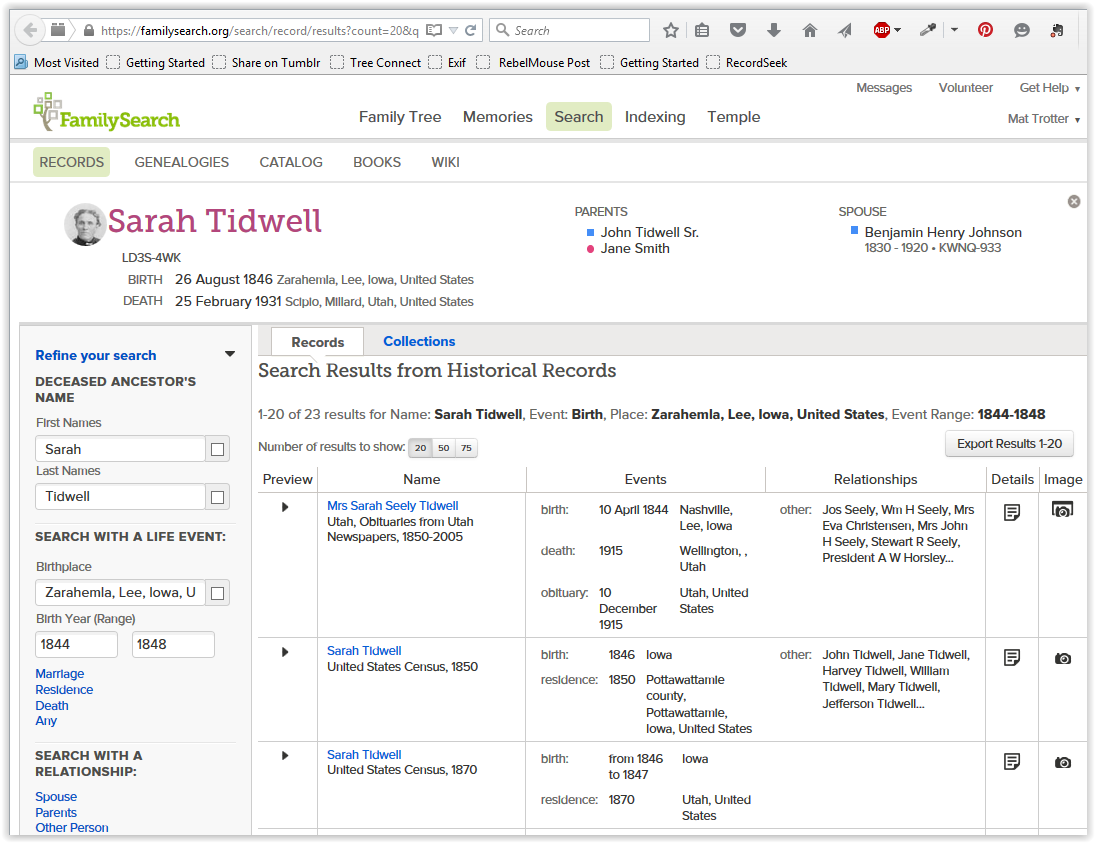
I then searched FamilySearch for Eugene. I found his name in the Texas Birth Index, 1903-1997. He is listed as the father to Sheridan Brooke Trotter, born 13 Sep 1953 in Brazos, Texas. The mothers name is listed as Floise Griffin, I can see this is a fat fingered Eloise or Elouise. I also found a U.S. WWII Army enlistment record for a Eugene W. Trotter from 20 Jun 1945 in Ft. Sam Houston, Texas. His birth year is listed as 1927. Same birth year and state as as the birth certificate, this information is backed up by the obituary.


This 1930 U.S. Census shows the Marcus Trotter family in Tom Green county, Texas. The baby Eugene is three years old and has one older sibling. His mother's name is Mable. This record supports the birth certificate found earlier.

My response to my mother was,
"I don't think we can prove how he is related to us. His Father's name was Marcus W. Trotter, the W is probably for Waldon. It looks like Eugune was probably born in Sterling City, Texas February 1, 1927.  Eugene's wife's name is Elouise Griffen Trotter and she passed away December 23, 2013. She was a missionary at Texas A&M and taught him the gospel before they were married. Their children are Sheridan, Nick, Robin, Rebecca, Claudia, and Malinda."
I also added the above information to my Legacy database so in the future if I can find more information to tie these Utah Trotters to my Trotters.

12 November 2015

Find, Take, Teach

Tonight I taught my first Find, Take, Teach class for members of my ward and stake. I think it went well, I hope those who attended got something out of it. As part of my employment I made a commitment to teach others the things I am learning.


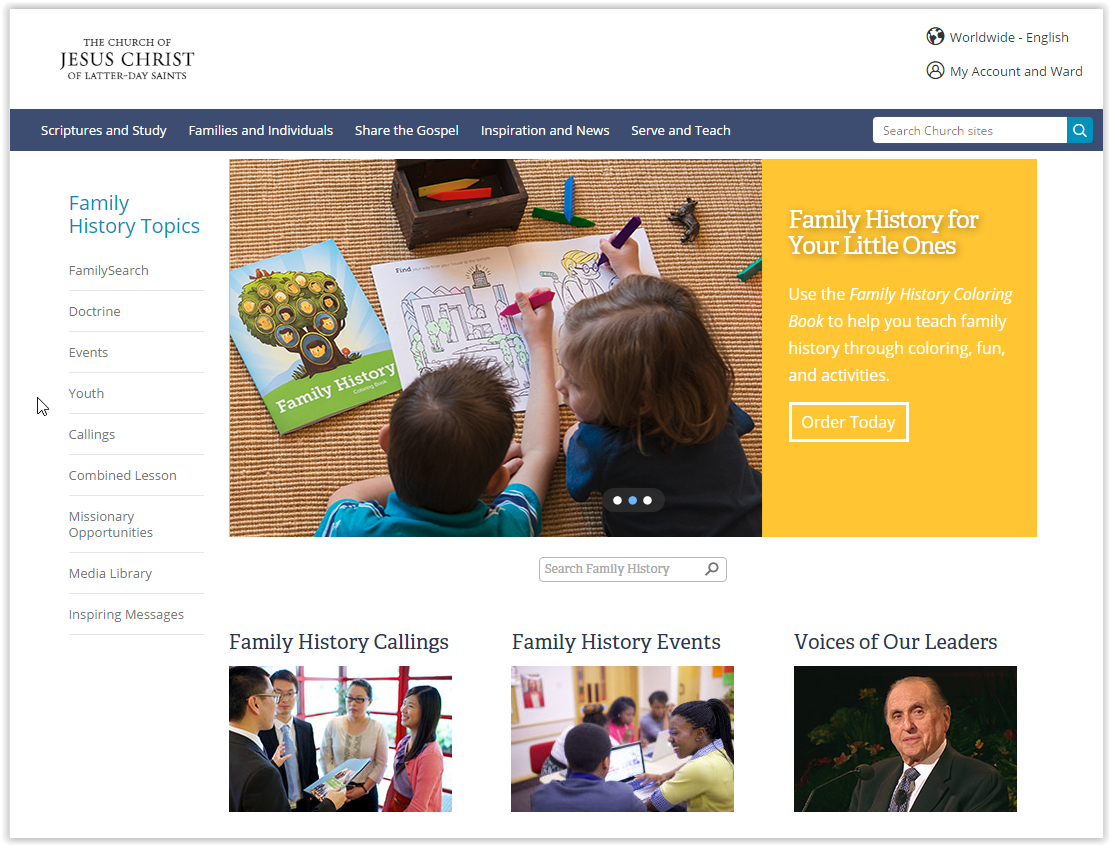
Tonight we talked about the resources available on lds.org. You can access them on the homepage, by clicking the Families and Individuals link in the menu bar and then click the Family History link.


Here you can find resources about FamilySearch, indexing, lessons, and doctrine. Clicking either the Callings link in the left side menu or the Family History Callings from below leads you to resources about fulfilling your callings and responsibilities.

 
Check out the resources from the consultant blog, training for your position, or the consultant webinars.


Next we talked about the App Gallery on FamilySearch. You can access the apps from the link at the bottom of the page as seen in the image above.


I have covered several of these apps (Kinpoint, Hope Chest, and Puzzilla) previously in my blog but I suggest that you try them for yourself. I should have also mentioned the apps that they are working on at BYU: Relative Finder, Grandpa's Pie, and Virtual pedigree.

We talked about other things as well as general questions but if you want the good stuff you need to come to the class.

Here are two takeaway handouts.

05 October 2015

Where did you go to school? 52Q W18

This week we will focus on the question:

Where did you go to school?

Good follow-up questions that go with this question are:
What was school like for you and what are some of your memorable experiences?
What were your favorite subjects in school and why?
What subjects did you like the least and why?
Who were some of your friends in school, what were they like, and what they are doing today?
If you went to college or a vocational school, where did you attend, and what subjects did you study?


It is interesting the information you can learn about a person based on the schools they attended. Last night I worked on an indexing project for schools in Oklahoma. The records I indexed had parents names and home addresses along with children's names, birth dates, ages, race, and gender. Sometimes the history of the school reflects the history of the people who attend the school.


I attended Provost Elementary School from kindergarten through sixth grade. Our mascot was the cougar which was appropriate for Provo, Utah. The school was named after Etienne Provost, a French Canadian explorer and trapper who is argued to be one of the first men of European descent to see the Great Salt Lake. The Provo river and Provo City were named after him. Provost live the end of his life in St. Louis, Missouri. He is considered a contemporary of Jim Bridger and Peter Skene Ogden.


Provost is one of 24 people memorialized on the This is the Place monument in the mouth of Emigration Canyon in Salt Lake City, Utah.

My memories of Provost are foggy. I remember Mr. Penrod who was my kindergarten teacher and eventually became principal. Mr. Shoemaker, my 5th grade teacher, who introduced me to the Apple computer and the 50 yard dash. I believe he also became a principal in the district. I had a relative who worked in the lunchroom. She is related to my grandma, Gloria Taylor Trotter. I cannot remember how they were related but I knew she watched out for me and loved me. We played games at recess like Red Rover and Pomp. I remember being very good at Pomp because I was a very fast runner and not so good at Red-Rover because I was small enough I couldn't break through the girl's arms. During the holidays the librarian would open the library early before school and a bunch of kids would go in and she would play the piano and we would sing Christmas carols. My friends Dick Dyer, Robbie Robertson, Bobbie Boyd, Murray O'Dell and I would sit on our skateboards and ride down the paved driveway in front of the school. The sixth graders were able to play in the band. I learned to play the Alto Saxophone but could not beat Tomika Young to be first chair. I had a crush on Tomika and once gave her my sister's new bear shaped earrings as a present, only to find out that Tomika did not have pierced ears. (Sorry about that Missy.) At the end of school year the sixth graders would tie the maypole and play the teachers in kickball, our class won the kickball game that year. I didn't much care for the maypole dance.


For 7th and 8th grades I attended Farrer Junior High School located on Center Street in Provo, Utah. We love our mountains. You can see Y Mountain and Squaw Peak directly behind the school. Mount Timpanogos is off to the left. Farrer got it's name from a Provo School Board member Bruce Farrer.

Photo taken, Tuesday, April 13, 2010 by PATRICK SMITH for the Daily Herald
In 2005 Farrer became an elementary school and in 2010 they tore down the old building and built a new school on the front field. When the new elementary school opened they changed the name from Farrer to Provo Peaks. I am not sure which is worse, naming a school after a school board member or a water park.

My memories of classes at Farrer are also foggy. I remember that I took two band classes, one for the sax and one for the clarinet. I was proud to be proficient at both instruments. I also remember dissecting a pig in class and I got sick. The mascot was an Eagle. The school had two giant ramps, on the east and west side, to get from the first floor to the second. There was also a staircase by the band room. I remember attending dances at the school. We didn't really dance we just kind of jumped around with our arms in the air to the beat of the song. I wanted to dance with a girl named Debbie Hill but just as I asked Michael Jackson's Thriller came on and she ran off to dance with her friends. I used to work for my lunch so in the mornings Dick Dyer and I would go in and set up the tables, and put the bags in the trash cans. For one year I went to school with my cousin Teri Jensen. She is my uncle Dick's daughter. We also played Buns Up, I was pretty good at that game.

When I was in junior high people would call the house phone and when I would answer they always thought I was my mom. Puberty plays mean tricks sometimes. Once when I was home the secretary from the school called and though I was my mom. It planted the seed of an idea. About a week later I decided I did not want to go to school so I called the secretary to pretend I was my mom to excuse me for the day. It didn't work, the secretary was not fooled and said, "Mat, I need to speak with your mother right now." I hung up the phone. I had a meeting with the principal the next day. I never tried anything like that again. For some reason I also associate my memory of Farrer with the movie Footloose. It was filmed in nearby Lehi, Utah and several students from my school said they were extras in the movie. I tried to cut and style my hair like Kevin Bacon. One time when Murray O'Dell and I were walking home from Farrer we found a bottle of alcohol next to horse pasture.  There was only a little left in the bottle. Murray was so excited to drink it. All I could think was that it was almost all backwash so I didn't try it. A boy cut off his index finger in woodshop, he lost it for good. We couldn't go in there for about a week. The boy had this cup shaped attachment to cover the scar. It was perfect for holding a joystick for video games. I thought he was the luckiest guy alive.


Timpview High School was named after the beautiful view of Mount Timpanogos. The Mascot is the Thunderbird and the sports programs are some of the best in the state. I played in the band for two years before dropping the class to focus on debate. We had a highly successful program until the year after I graduated when they killed the debate all together at the school. I attended most of the dances, learned to drive, and decided to go to college while a student here. I stopped hanging out with my neighborhood friends and started hanging out with Kim Brown, Jim Pier, and any girls that would allow. I dated several girls and burned a couple friends. In the off season for debate we would have a murder mystery and then a court case to determine the killer.  I felt out of the mainstream and rejected by most of the student body. I got suspended for fighting once with a kid we called food. I regret calling him food. I regret the fight. I think sometime when we feel picked on we pick on others to make ourselves feel better. I don't know why. I went to School and debated with Mike Lee, who became a U.S Senator for the State of Utah.

While at Timpview I traveled to Phoenix, San Francisco, Boston, and Berkeley. When I graduated I entertained scholarships from Harvard, Arizona State and Weber State. All of these schools were ranked in the top five nationally for debate with Weber State at the top spot.


28 September 2015

Where do you find records? 52 Questions Week 17

This week we will focus of the question:

 Where do you find records? 

We have gathered information and decided to begin looking for a specific ancestor. As a beginner we want to start with the information that we know.


I always begin my search at FamilySearch, the largest collection of genealogical and historical records in the world. The best part is that it is free to use either with or without a free account.


The search feature allows you to search by Name or Location. To search by name enter in information on the left side of the page. Sometimes adding or removing information from the search will give you more or less results. It is a good practice when searching to start with a small amput of information and then narrow the search.


For this search I want to learn more about my second great-grandmother Christina McKay and her family. I know that the image says third great-grandmother but my legacy database hase my oldest son as record number one so I can have all of my data in one database.


I know that She died in 1925 in Los Angeles,  I will begin with a search there. I decided to use the name search and I entered her name and death place and date.


The top five search results were for my Christina and two of these were records for her death. It is ok if the birth date is not quite right because we are focused on the death information. If this were birth records we would have to look more closely.


The Find a Grave record and the California Death Index record confirm this is my Christena. The headstone from Find-A-Grave gives me her Husband's Birth and death year. I also know burial custom is that one or both of  them must have lived in or near Pamona, Calfornia at some point in their lives because that is where the grave is located.

The 1900, 1910, and 1920 Census records confirm Christena living in California first with her husband Everett but in 1920 with her daughter. This backs up the dates from the headstone that Everett most likely died before the 1920 census.


The biggest clues from the census records is that Christena's birthplace is listed as Canada and both of her parents were born in Scotland. Other information contained here is that her birthdate is in Dec 1954 and she immigrated to the United States in 1884. Both of these dates are secondary and need to be supported with primary sources but they provide great clues as to when to look for more information. It also says they have been married for 28 years so they were married around 1872.


A quick search for a Christena McKay married in Canada between 1871 and 1873 find an Ontario, Canada Marriage record between Christina McKay and Everett Merriam. I cannot show the image of the record because of Intellectual agreements but the information from the record gives us more clues for where to look for more information. Everett's parents names are Justus and Caroline Merriam. His brothers marriage record is on the same page and his name is Rustin Merriam. They lived in Chatsworth, Canada when Everett was married at the age of 23. Christina's parents are Angus and Hannah McKay. They lived in Sydenham, Canada when Christina was married at the age of 18. They were married on September 24, 1872 in Owen Sound, Grey County, Ontario, Canada by Rev. William Tindall. Everett's brother was married the same day.


25 September 2015

New Way to Search Partner Sites From FamilySearch


I logged onto FamilySearch tonight and noticed in the search record field the logos from the partner sites.


Clicking the FamilySearch logo takes you to a familiar page with search results for the persons whose profile page you searched from. The top five results were for my person.


The Ancestry.com logo has the same functionality as the FamilySearch link. The top nine results were for my person.


The find My Past search resulted in a total of four results, all for my person.


The MyHeritage results were mixed but among the top 20 results were three family trees for my person.

This search along with the hinting feature have made FamilySearch a first stop for searching for ancestors.


20 September 2015

Original Research, Where Should you Start? 52Q W16

This week we will focus on the question

Original Research, Where Should you Start?

Now that we have gathered information, organized our records, and decided what we want to learn about it is time to plan out where to begin.


Depending on your goal, or the question you want and answer for, you may need to break up the goal into small steps. Like I talked about in last weeks post, you need to start with an individual or family  you could research to move you toward your goal. These closer relatives are usually easier to research and will give you a great foundation and more information for the path to the answer of your question.


If you use a tool like Kinpoint to visualize holes of missing information it is important not to start with the hole but with the closest relative for which you have information.

It is easy to be distracted from your main goal and follow research in a different direction. Sometimes this side research can be fruitful but it is best to stay within the same family and within your goal. Start with the easiest research goals first and progress to the harder goals.  If you come across a trail of information you can always create a to do list or another research log about what information you may find and set it aside for when you complete this goal.


Crista Cowan work for ancestry.com and she vlogs about many different genealogy and Family History topics. The above YouTube video is about To-Do Lists.


I use Legacy to keep track of my to-do lists. With the To-Do list I can separate out visits to the Family History Library so I can get copies of the indexed records I have found. I also add a to-do if I think of a place to look for more information about a specific individual. The main purpose of the to-do list is to help keep you on task with your goal. 

This helps you with a larger question of where to start, so every time you sit down to do work you have a great list of places to start. In coordination with your research log it makes your start up time shorter so you can spend more time doing actual research.

13 September 2015

What do you want to learn about your #FamilyHistory? 52 Questions W15

This week we will focus on the question -

What do you want to learn about your #FamilyHistory?

Follow-up questions that go with this question are:
Do you have a burning question about the family that you would like to know the answer?
If you had questions about your family, who would you turn to for the answer?
Do you have any information about this person in your records?
What information do you have to link you to this person or event?

 
Deciding on a research objective is the next set in learning about your family history. Sometimes you need to set several different objectives to reach the end goal if what you really want to learn. It is important not to pick to large of an objective. It is best to set smaller goals that will help to lead you to the bigger goal or objective.

It is important to research only one objective at a time. Objectives should be small and based on events. Start from what is known to the unknown, sometimes this means starting with a death certificate or a grave and working toward a marriage or birth certificate. It is also best to work within family groups one at a time and not large branches of your tree. Each step you make will lead to more and more information.

The minimum amount of information you should find for a person is their name, gender, approximate birth date and place, and their death date and place. Marriage information is also a great way to expand your tree and find more related documents and sources.

By no means am I an expert but I have a desire to learn and have had my own experiences of trial and error.
Henrietta Inez Moler Merrian Green (1896-1966)
For years I worked to try and chip away at the Trotter family brick wall. A task that I am still working on but need to focus on something else for a while. You can only bang your head against a wall so many times before you learn your lesson. I took a look at my fan chart and saw the blank spaces from my maternal grandmother's family.

My uncle Michael Hill had done a lot of genealogy work on the family in the 80's and had presented my mother a book of printed pedigree charts and family group records. In all of his efforts he was unable to find any information on my grandma's line. FamilySearch also did not have any information populated into my tree. I decided I would take a look at this line and see if there was any information I could find now that 30 years had past since uncle Mike had worked on the line.


When I was a child my mom told me the family tale that the Merrian family had come from Nottingham, England. They they were part of Robin Hood's merry men and lived in Sherwood Forrest.  The thought of being a descendant of these people gave me a lot of pride and many visions of grandeur.

There were few real pieces of evidence I had to go by but another more plausible story I heard about my grandmother's name gave me a place to start. My grandmother was named Wilberta Annette Merrian Bartholomew and she said that she was named after her father Wilbert. He was expecting to have a son so they settled on naming him after his father but when she was born they gave her a feminized version of his name. I was fairly certain that her father's name was Wilbert Merrian.


Because Wilberta is such an unusual name it make it pretty easy to use as a search term. I quickly found her in the 1930 U.S. Census living in Reno, Nevada. A record my uncle Mike would not have had access to. In the census I found the family of Alfred W. and Henrietta I. Merrian along with their children Wilberta, James and Ruth. This record also states that Alfred as well as his father were born in Canada. It also says he immigrated to the United States in 1892.


In the 1920 Census in Reno, Nevada I found the entry for A. W. [indexed as H. W.]  and Henrietta Merrian. Both A. W. and his father are listed as being born in Canada. I am almost positive this is my great-grandparents. A bonus from this record says he immigrated to the United States in 1898.


A 1918 World War I Draft Registration Card lists a birth date as June 7, 1879 for Alfred Wilbert Merrian. It also lists his nearest relative as Henrietta Moler Merrian, and they are living in Sacramento, California. I am sure these are my great grandparents despite the change in his name.

 Following steps like these I was able to verify the members of my family across Canada to Connecticut. A process I will outline in another post.

07 September 2015

How do you organize your #FamilyHistory? 52Q W14

This week we will focus on the question -

How do you organize your family history?


Over the last 13 weeks we have focused on gathering information for our family history research. This is the first major step when beginning your research. We should have a good foundation of what you know about your family. It is important to organize the information to keep your records safe and to help you find your information quickly.

This base of information is what the rest of your family history research will grow from. Being organized helps you to more easily collect sources and then compare and evaluate them. There are several different established methods for filing records. I cannot say that I use the best method. What I do know is that I have a system that works for me and where I can recall information and sources easily. This is key when putting your files together.

I have used the physical color-coding system developed by Mary E. V. Hill. I gave the shopping list to my wife and kids for a fathers day gift. I cannot say I have used this method to its fullest potential. However, Legacy has a feature where you can color code for families to match Mary E. V. Hill's color coding system.

I use and trust my electronic filing system the most. Although not perfect, I am able to find and add information for my families. When I began one of the bits of advice I followed was that it was more important to document your sources that to worry about how you are documenting your sources. I tried a method that made sense to me and then followed. I have found since that there are some complication to this process. The biggest of which is that it is time consuming to change your electronic filing system after you have already started. Any change will break the links to your files and must be repaired one by one.


I group my files into folders by family name. This seemed pretty straight forward until I had the same family name on two different sides of my family. This problem is solved if you keep your family files grouped together in separate folders. So if I had put all of my mother's relatives into one folder and my father's relatives into another. This system also causes issues when trying to find files afterward.

One suggestion that was made was to file information by location. I created a tree of information based on country, state, county, and city. I found that using this method for all sources put to many files together into the same folder.

I settle on using a hybrid between the two methods. I use location information for cemetery information, maps, plats and other location specific information. I keep all other records with names included by family name. I keep file folders with all of my direct relative's surnames in the top file and any different surnames that descend from my direct relatives name in sub folders. Above you see my Bartholomew family folder. The Keller, Nelson and Stewart files are all surnames of daughters who were married and whose names change. I am related to these families but not directly so the folder is not in the top or main folder.

Legacy assigns each individual a Record Identification Number or RIN. When I save a record I use the name of the main person who the record is about followed by a short description and then the RIN. The short description is not needed but I have found that after I create the record it is easier to save to me database with the description. My short descriptions include obit for an obituary, died for a death certificate, birth for a birth record, grave for a headstone or monument, etc. If the record contains two names I use the RIN of the person with whom I am more closely related.


My only exception to this rule is for census records. Because census records often contain the records for more than one family, my naming standard begins with the year of the census, then the name of the oldest relative on the page, then the RIN. If the census record covers more than one page I add a page count after the surname but before the RIN. [See example above.]


In addition to the family and location folders I also use a source folder. I have found that some sources are not family or location specific. In these cases I add the digital copy of the source to the source folder without including a specific name or RIN.


31 August 2015

Do you have any official family documents? 52 Questions W13

This week we will focus on the question -

Do you have any official family documents?

Good follow-up questions that go with this question are:
Do you have birth, marriage, or death certificates for family members?
Do you have deeds, wills, or similar old items which mention the family?
Do you possess or know of certificates or papers from lodges, clubs, or veterans groups?
Do you possess or know of military certificates, discharges, or papers?
Can you give locations of family burial plots?


Now is time to gather family documents. The FamilySearch wiki lists official documents as:
  • Certificates of birth, marriage, and death
  • Wills, deeds, and property records
  • Military service and pension documents
  • Passports
  • Naturalization documents
  • Medical records
  • Licenses (business, marriage, fishing, driving)
  • School records
  • Insurance policies
Search all of your family storage areas, closets, basements, garage, trunks, safe, deposit boxes, and so forth. Encourage your relatives to make similar searches in their storage areas. You may have a relative who may have already gathered some family information.

Keep a record of contacts with family members on your research log. This will help you avoid duplicating your work and can help in following up later. Write notes about interviews, meetings, and reunions. Make copies of e-mails and keep copies of letters.
A research log is a comprehensive list of sources you already searched, or plan to search including the purpose of each search. A summary of significant findings and comments about your search should also be included.


Organizing and documenting as you go saves time in the long run. Documentation makes it easier to find and evaluate your of sources of information. If you wait, you may never do it. This results in lost and wasted time gathering information. You can have a research log for each location, ancestor, or family. Keep it simple. There are different formats for research logs depending on what information you are trying to find.

As a Legacy user I have been using the To-do list as my research log. This is one of the suggestions made in software training's I have taken. The results tab allows for you to report what you have or haven't found and the result of your search.

26 August 2015

Where is your family from? 52Q W12

This week we will focus on the question -

Where is your family from?

Good follow-up questions that easily go with this questions are:
Does your family identify with a specific culture?
Do you follow customs or traditions that were passed down to you?
Can you identify a family members who emigrated to your country?
Do you have family groups in other parts of the country and world?
Do you know the family members who migrated to your area?


Immigration is the movement of people into a country to which they are not native in order to settle there, especially as permanent residents or future citizens. Emigration is the act of leaving one's native country with the intent to settle elsewhere. Migration is the movement by people from one place to another with the intention of settling temporarily or permanently in the new location.

The usage of family in this question refers to your family in general and not necessarily your immediate family. Family groups form over time and through marriage. Families also migrate and emigrate to different areas. Following these groups of families can help you to trace your family history.

Where is my family from?
This is a question that is based on perspective. My wife and children live in Ogden, Utah. My mother and father also live in Utah but live just over an hour away in Provo. They live in my paternal grandparents, home. Both sets of my grandparents lived and died in Utah during my lifetime. I can safely say that my family is from Utah.

How did they get here?
This for me is the bigger question. As we trace our family history is it important to understand how they arrived where in the location they or their records are found. The four main branches of my family are a great example.

Samuel and Emma Facundus Trotter

The Trotter family came to Utah in 1899 from Louisiana. Samuel Trotter and Emma Irene Facundus investigated and were baptized members if the Church of Jesus Christ of Latter-day Saints or Mormons in Saint Helena Parish, Louisiana in 1896. almost four years later they boarded a train that brought them west to Utah. They had eight children, one dying as an infant, who were all raised and lived in Utah. I have record of 243 of their descendants in my personal database, most of whom live in Utah.


Benjamin Franklin Taylor migrated twice. First in 1817 with his parents to Lorain County, Ohio from Berkshire County, Massachusetts. In 1840, Benjamin and his wife Ann were baptized members of the L.D.S. Church and started migrating with the Saints in 1843 as they were persecuted in the Midwest and by wagon train to Utah in 1850.

Joseph and Polly Benson Bartholomew
The Bartholomew family came to Utah in 1820 from Indiana. Joseph Bartholomew was raised by his grandfather after his father died when he was 7 and his mother followed in death when he was ten. A family history tells that Joseph was not treated well by his uncles and his grandfather was consumed by political and land dealings. Joseph followed his older sister Christina who had been baptized a Mormon and was leaving Illinois because of persecution. Christina died on the journey and Joseph was taken in by a Mormon family named Benson. Joseph later married Polly Benson and they settled in Fayette Utah.

Alfred and Henrietta Moler Merrian

The Merrian/Marriam family came to Utah when my grandmother Wilberta Merrian Bartholomew moved here with my grandfather to settle and raise their family. They met in Reno, Nevada. I mentioned them in my W6 grandparents post as well as the W2 Where were you born? post. My great-grandfather died in Nevada in 1947 and then my great-grandmother moved to Utah and married again.

The Merrian/Merriam family story is a complicated one. I hope I have documented it correctly and I will review this line as I take classes at BYU Idaho in the Family History program. I believe that they changed their name as they moved back to the United States from Canada in the 1880s. I say back because the Merriam's were loyalists during the Revolutionary War and fled to Canada when the war ended.

Where is my family from?
I understand how my family arrived in Utah. Most of the migration was because of the LDS church and its Westward migration. In the case of the Merrian's, they came to Utah for through marriage. But how did these families come to be in the United States.

How did they get here?
I am at a brick wall with the Trotter line in Louisiana. Although Samuel's travel to Utah is documented little is known about his father. I have information about his mother but nothing about her relationship with Samuel's father.

It looks like the Taylor family came to Connecticut from England around 1640. I have not documented this line so this may not be the truth. However, several family histories have this line as their story.

The Bartholomew family emigrated to Philadelphia aboard the ship William and Sarah from the Netherlands in 1727. Johan and Dorothy Endt Bartholomew had 16 children. I cannot image how many descendants they have.

I found success in tracking the Merriam family across Canada from Connecticut but I am at a brick wall beyond this loyalist ancestor and his wife, John and Susanna Johnson Merriam.